From video frames to movement signals
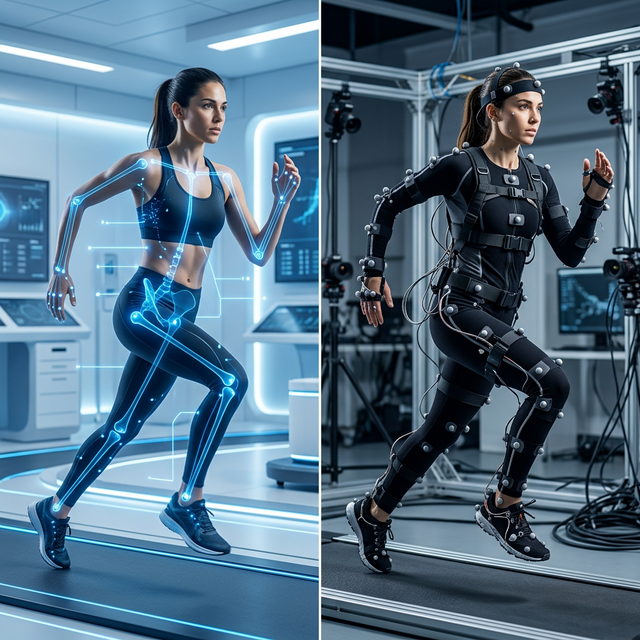
A camera does not directly see a knee angle, a hip strategy, or a compensation pattern. It sees pixels. The engineering challenge is to turn those pixels into a time series that has biomechanical meaning.
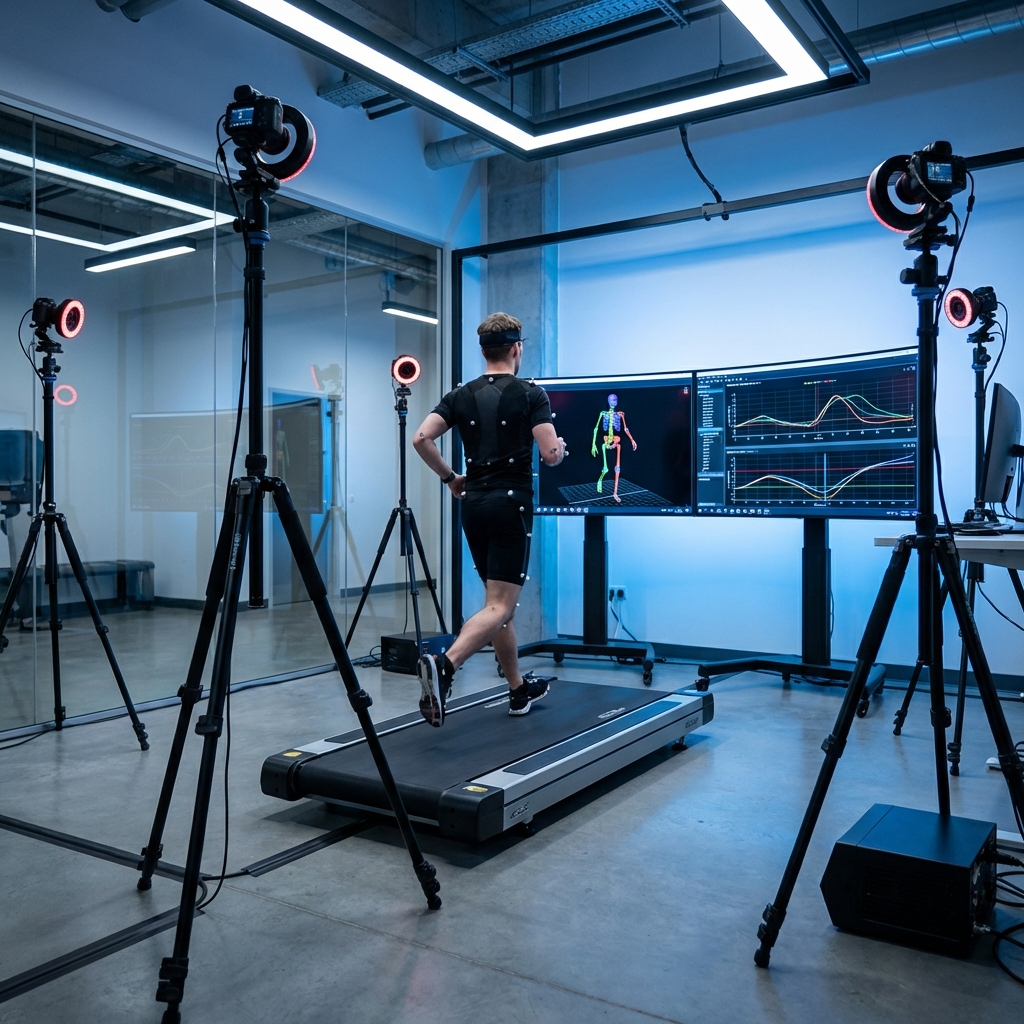
In a single-camera workflow, the system first identifies body landmarks in each frame. It then organizes those landmarks into a human pose model, tracks how the pose changes over time, and estimates angles or movement features that can be reported consistently. The visible output may look simple, but each number depends on a chain of assumptions.
A serious product should make that chain understandable enough for clinicians, coaches, and researchers to judge whether the output fits their use case.
Pose estimation is only the first layer
The first layer is landmark detection: locating points such as shoulders, hips, knees, ankles, and other anatomical references in the image. Modern computer vision models can do this with impressive speed, but a landmark is not yet a clinical or performance metric.
Landmarks need to be checked for visibility, confidence, anatomical plausibility, and continuity between frames. Occlusion, loose clothing, camera angle, fast movement, and unusual body positions can all affect the signal. The product has to decide when to accept the estimate, when to smooth it, when to warn the operator, and when to reject the capture.
This is why HoloMotion treats AI estimation and workflow guidance as connected problems. Better models help, but better protocols also help because they reduce ambiguity before the model has to solve it.
Joint angles are constrained by anatomy and protocol
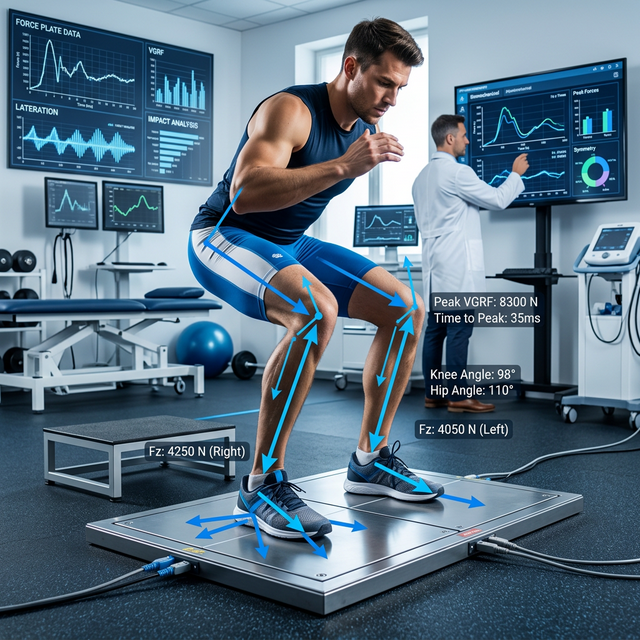
A joint angle is not simply the angle between two lines drawn on an image. It reflects how the body segment is defined, which anatomical landmarks are used, which plane of motion is being estimated, and whether the camera view supports that estimate.
For example, a frontal-view movement and a side-view movement provide different information. A squat, gait sequence, lunge, shoulder task, or sit-to-stand assessment may each need a different protocol because the meaningful features are not identical.
The important product decision is to avoid pretending that every movement can be measured with the same confidence from every angle. Protocol transparency protects both the user and the subject.
Temporal consistency matters
Movement is a sequence, not a snapshot. If the model estimates a knee location in one frame and a slightly different location in the next, the resulting angle can jitter even when the person moved smoothly. Temporal processing helps convert frame-level estimates into a more stable signal.
But smoothing has to be handled carefully. Too little smoothing can exaggerate noise. Too much smoothing can hide quick changes that matter for performance or control. A well-designed system balances stability with responsiveness and should make the reporting context clear.
This is why trend lines, phase segmentation, and repeated trials often tell a richer story than a single peak value.
What to ask when evaluating angle claims
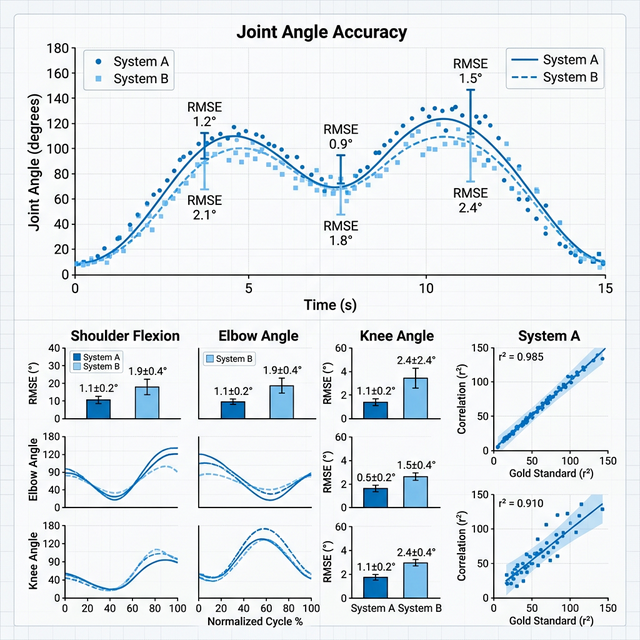
Teams evaluating AI joint-angle products should ask practical engineering questions, not only compare headline accuracy numbers.
- Which movements and camera views are supported?
- How are landmarks defined and how is confidence handled?
- What happens when a joint is partially occluded?
- How are noisy frames smoothed or excluded?
- Can the system separate capture-quality warnings from movement findings?
- Are outputs designed for longitudinal comparison across sessions?
Good answers to these questions make the system easier to trust. Vague answers usually move risk into the user’s workflow.
Evidence boundary
HoloMotion public accuracy language should be read as internal benchmark and technical validation under documented capture conditions. This article is an engineering explanation, not a peer-reviewed methods paper. It does not claim external clinical publication, standalone diagnostic status, or jurisdiction-specific clearance.
Where to read next
For implementation details, continue with Technology and Science.